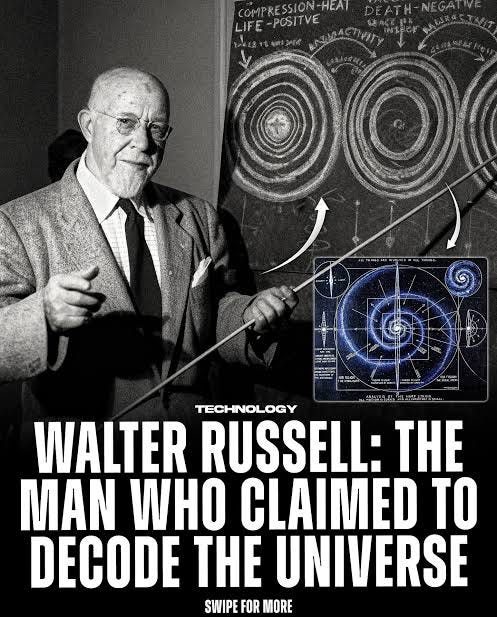

Hello FRIENDS! I just gotta say, Walter Russell is a legend of a man to research. Imagine a figure who mastered the chisel as effectively as the periodic table—a man who viewed the universe not as a collection of cold, hard facts, but as a rhythmic, luminous poem. Russell was the quintessential 20th-century polymath, a “Modern Leonardo” whose life bridged the gap between Gilded Age portraiture and radical atomic physics.
Our developed outlines deconstruct his 1921 “illumination,” a 39-day cognitive shift where Russell claimed to perceive the fundamental wave-geometry of reality. This wasn’t mere mysticism; it produced the Spiral Periodic Table, a harmonic mapping of matter that predicted isotopes like Deuterium and Plutonium years before their laboratory isolation. His “Electric Universe” posits that all matter is light-waves compressed into motion, governed by the universal law of Rhythmic Balanced Interchange.
Beyond the laboratory, Russell’s influence was tectonic. He pioneered the Equity-Cooperative model in New York real estate, erecting “monumental” structures like the Hotel des Artistes to provide financial stability for the creative class. His twelve-year tenure at IBM as a consultant to Thomas J. Watson infused corporate culture with the “Science of Man,” arguing that ethical integrity is a mathematical prerequisite for systemic success.
Perhaps most haunting is his 1957 manifesto, Atomic Suicide?, which framed radioactivity as a death-cycle of matter that humanity was prematurely unearthing. His correspondence with Nikola Tesla—who famously advised Russell to lock his knowledge away for a millennium—solidifies his status as a thinker who lived centuries ahead of his time. Russell’s legacy remains a peer-reviewable challenge to unify art, science, and ethics into a singular “Still Point” of creative agency.