The Cured Fit
The Earth as Craftswoman

Chapter-1-
For five centuries, the human intellect has been haunted by the ghost of a tool that never existed. When we stand in the shadow of the Great Pyramid at Giza, or run our fingers along the cyclopean, zig-zagging ramparts of Sacsayhuamán in the Peruvian Andes, we are participating in a global ritual of cognitive dissonance. We gaze at blocks of granite, andesite, and diorite—materials that rank just below diamond on the Mohs scale of mineral hardness—and we observe a phenomenon that defies the logic of the industrial age. We see joins so tight that a human hair cannot find purchase. We see multi-ton megaliths that curve around corners with the fluidity of soft wax, maintaining a zero-tolerance seal that has survived millennia of seismic upheaval.
And then, we begin to hallucinate.
Because we are children of the Industrial Revolution, our brains are hard-wired to perceive precision as a result of violent subtraction. To us, a fit is something achieved through the relentless application of force: the bite of a steel saw, the grit of an abrasive, the high-energy pulse of a laser, or the steady, rhythmic impact of a chisel. We view the ancient mason as a combatant—a lone figure battling a stubborn, inanimate enemy. We assume that if the fit is perfect, the tool must have been divine. This is the Mechanical Fallacy. It is the arrogant, modern insistence that human ingenuity is the only architect of order. It is the belief that if we cannot replicate a structure using our current mechanical paradigm, then the ancients must have possessed a lost technology that mirrors our own, only better. We invent sonic drills and plasma cutters to fill the void of our own misunderstanding, never realizing that the void exists only because we are looking for the wrong kind of ghost.
The Mechanical Fallacy has turned archaeology into a hunt for phantoms. We dig for the diamond-tipped saws of the Pharaohs and find only copper bow-saws and dolerite pounders. We search for the advanced machinery of the Inca and find only stone hammers and bronze pry-bars. Instead of questioning our premise, we double down on the mystery. We create television specials about ancient aliens and subterranean high-tech laboratories, all because we refuse to accept a truth that is sitting in plain sight, etched into the very geochemistry of the stones themselves.
The truth is that the impossible precision of the ancient world was not an architectural intent achieved through advanced tooling. It was an emergent property of a planet in transition. The builders—men of immense skill, certainly, but men nonetheless—provided the seed: the roughly positioned, heavy masonry. The Earth, through a catastrophic sequence of geochemical events, provided the seal. We must stop asking how they cut it and start asking how it cured.
The Industrial Bias: A Prison of Perspective
To understand why the Mechanical Fallacy is so pervasive, we must first examine the prison of our own perspective. Since the mid-18th century, the human experience has been defined by the machine. We have conquered the physical world through Discrete Manufacturing—the process of taking a raw material and carving, molding, or stamping it into a specific shape before assembly. In this paradigm, the fit happens at the end of the process. It is the final, fragile result of thousands of preceding, precise cuts. When a modern engineer looks at a wall in Ollantaytambo, they see thousands of individual decisions made by a tool. They see the angles, the sunken reliefs, and the interlocking pillowed faces of the stones, and they calculate the man-hours required to achieve such tolerances. They conclude it is impossible because, in a discrete manufacturing environment, it is impossible. The labor required to manually abrade two 50-ton blocks of andesite until they achieve a vacuum seal would take generations for a single join.
But nature does not work through discrete manufacturing. Nature works through Diagenetic Synthesis. Consider the common river pebble. It is perfectly smooth, often possessing a symmetry that suggests a master jeweler’s touch. Yet, no tool touched it. The precision of the pebble is an emergent property of the environment—the constant, hydraulic interaction of water, silt, and time. Or consider the way two ice cubes in a tray will fuse into a single, seamless mass if left to sit. There is no join between them; they have undergone a phase change that rendered the boundary irrelevant. The megaliths of the ancient world are not the result of a cut fit. They are the result of a Cured Fit. By applying the Drenthian Polymathic Distillation Protocol, we can strip away the mechanical noise and observe the Simple Truth of the material. We are looking at stone that was once subjected to a tripartite cycle of geochemical agony: Hydrolytic Softening, Pressure-Solution Creep, and Atmospheric Re-lithification.
The Silence of the Stone
If you look closely at the impossible joins at Puma Punku in Bolivia, you will notice something that the lost technology theorists often ignore: the silence of the stone. When you cut stone with a mechanical tool, the stone screams. It leaves behind striations—microscopic or macroscopic grooves caused by the passage of the blade or the abrasive. It leaves behind heat-fractures and bruising at the molecular level where the force of the impact exceeded the stone's elastic limit. Modern high-speed saws leave a signature that is unmistakable under a microscope. The megalithic joins of the high-culture sites are eerily silent.
The surfaces are not cut in the traditional sense; they are interstitial. They follow the contours of the neighboring stone with a biological intimacy. In many cases, the stones seem to flow into one another, with the boundary line acting less like a crack and more like a fused suture in a skull. This is not the signature of a saw. This is the signature of Pressure-Solution Creep. Under specific conditions of saturation and immense pressure—conditions provided by the global eustatic transgressions of the Younger Dryas—silicate rocks do not behave like rigid solids. They behave like highly viscous fluids. Through a process known as silicate hydrolysis, the strong chemical bonds of the stone are temporarily weakened by the presence of activated water. When you take two such softened blocks and subject them to the weight of a 100-meter column of water or the shifting tectonic pressure of a planet in upheaval, the stones do not break. They creep.
The atoms at the point of contact literally dissolve and reprecipitate into the gaps. The stone heals its own joins. It cures into a state of Interstitial Conformity. The ancients didn't need lasers because they had the ocean. They didn't need diamond saws because they had the weight of the world. The Mechanical Fallacy has kept us looking for a hammer when we should have been looking at the tide.
The Alchemy of Agony: Hydrolytic Softening
To understand the Cured Fit, we must first dismantle our most basic assumption about the nature of stone. We perceive granite, andesite, and diorite as the ultimate symbols of permanence—fixed, rigid, and defiant. We see them as the bones of the Earth, immutable unless met with the violent force of a diamond blade. But this is a perspective born of a dry, stable epoch. In the eyes of geological time, stone is not a solid; it is a slow-moving liquid, waiting for the right catalyst to resume its flow. That catalyst is Active Water.
In the traditional archaeological narrative, water is an agent of destruction. It erodes, it carries silt, it freezes and cracks. But in the Drenthian Paradigm, water is the primary solvent of the Great Work. We are not talking about the gentle rain of a modern afternoon. We are talking about the environment of the Terminal Pleistocene—an era defined by the Younger Dryas Boundary and the catastrophic meltwater pulses that saw global sea levels rise by hundreds of feet in mere centuries. When stone is submerged under the immense hydrostatic pressure of a transgressing ocean—or saturated by the chemically aggressive runoff of a melting ice sheet—it undergoes a process known as Silicate Hydrolysis. This is not a theory; it is a fundamental principle of geochemistry, documented extensively in the study of Saprolitization.
As noted by R.R. Anand in his seminal work on the kinetics of silicate hydrolysis, when silicate minerals are subjected to saturated, high-pressure environments, the strong covalent bonds between silicon and oxygen are attacked by hydrogen ions. The water doesn’t just sit on the surface; it activates the stone. It penetrates the crystal lattice, weakening the molecular scaffolding that gives granite its rigidity. In the laboratory, we see this manifest as the transformation of hard rock into saprolite—a material that retains the visual texture of the parent stone but possesses the structural consistency of dense clay. Imagine the ancient builder not as a man preparing a mold. The stones of Sacsayhuamán were not quarried in the modern sense. They were harvested from the softened strata of a planet undergoing a geochemical crisis. Under the conditions of the Neptunian Synthesis, the andesite was not a brittle enemy; it was a plastic medium. It was cured into place. When we see the pillowed faces of the megaliths—those bulging, organic surfaces that look like rising bread—we are not looking at an aesthetic choice. We are looking at the literal slumping of stone that had reached a state of Hydrolytic Plasticity.
The Saprolite Proxy
Modern archaeology often dismisses the possibility of softened stone because they look for it in the wrong places. They look at the dry, sun-bleached blocks of the present and conclude they must have always been this way. They ignore the reality of Diagenetic Reversion. When we examine the works of Anand regarding saprolite formation in saturated environments, we find a perfect proxy for the Drenthian Cured Fit. In nature, the transition from hard rock to saprolite occurs when the rate of chemical weathering exceeds the rate of physical erosion. In a world submerged by the Younger Dryas meltwater pulses, the entire planet became a laboratory for this transition.
Consider the Precision Join once again. In a dry environment, placing two 50-ton blocks together creates a point-contact fit—the microscopic irregularities of the stone prevent a total seal. But in a Hydrolytic environment, those point-contacts become zones of extreme localized pressure. Under the weight of the masonry and the added hydrostatic pressure of the surrounding water, the softened crystals at the interface do not shatter—they dissolve. This is the transition from Hydrolytic Softening to Pressure-Solution Creep. The stone at the join literally melts at the molecular level and reprecipitates into the microscopic voids. The two blocks do not just sit next to each other; they weld through a process of interstitial migration. The join disappears not because it was cut perfectly, but because the boundary between the two stones became chemically irrelevant. The Mechanical Fallacy insists that the ancients possessed a tool to cut a 1/1000th of an inch gap. The Drenthian Paradigm recognizes that the planet possessed a process to eliminate the gap entirely.
The Evidence of the Pillowed Face
If you require proof of this state of plasticity, look no further than the bosses or nubs found on the faces of megaliths from Egypt to Peru. Orthodoxy calls them handling lugs used for ropes—a claim that falls apart when one realizes that many of these nubs are located in positions that would make them useless for leverage, or are found on stones so heavy that no rope of the era could have supported them. In the Drenthian Polymathic Distillation Protocol, these nubs are not tools—they are Exudation Points.
When a hydrolytically softened block is subjected to the massive pressure of the stones above it, the internal pressure must find a release. Just as mud will squeeze through the gaps in a clenched fist, the softened interior of the stone was forced outward through the pores of the semi-rigid surface crust. The nubs are the frozen remnants of a geochemical degassing and pressure-relief event. They are the Petrified Record of the stone’s temporary transition into a non-Newtonian fluid. The reason we don’t see this happening today is simple: the Active Water is gone. The planet has moved into its Atmospheric Re-lithification phase. The Cured Fit has set. We are living in the dry era of history, looking back at a wet era and trying to explain the results using dry logic. We are like a person who finds a ceramic vase and assumes it was carved from a solid block of clay using a high-speed drill, completely unaware of the existence of the potter’s wheel and the kiln. We have forgotten the Potter of the ancient world: the hydro-isostatic pressure of a world in flux.
The Academic Aegis: Refuting the Solid-State Dogma
To the skeptics who argue that silicate hydrolysis takes millions of years, we point to the Bayesian chronological analysis of the Younger Dryas Boundary (YDB). As researchers like James Kennett have demonstrated, the transition of the terminal Pleistocene was not a slow, uniformitarian crawl. It was a sequence of punctuated equilibrium events—catastrophic pulses that compressed geological time into human time. Under the extreme heat of atmospheric impact events and the subsequent Thermal Shock of global flooding, the kinetics of silicate hydrolysis are accelerated by several orders of magnitude. We are not talking about slow soil formation; we are talking about Shock Diagenesis.
When the Mechanical Fallacy theorists point to the Mohs hardness of granite, they are citing a value for a dry, stable specimen in a laboratory. They are not citing the hardness of a granite block submerged under two atmospheres of pressure in a chemically aggressive, mineral-saturated flood-surge. By ignoring the environmental context, they are ignoring the primary tool used by the ancients. The impossible joins are not evidence of a lost high-tech past. They are the Geochemical Signature of a planet that was, for a brief and violent window of time, a master craftsman. The builders were not cutting to a tolerance of microns; they were simply placing blocks in the path of a geochemical inevitability. The precision was not the goal. The precision was the result.
The Gravity of Fusion: Pressure-Solution Creep
If Hydrolytic Softening is the process that prepares the stone clay, then Pressure-Solution Creep is the invisible hand that performs the final, perfect join. To the adherent of the Mechanical Fallacy, a 50-ton block of granite is a static burden—a problem of transport and placement. In the Drenthian Polymathic Distillation Protocol, that 50-ton block is something else entirely: it is a Hydraulic Vice. To understand the impossible precision of the ancient world, we must look at the work of E.H. Rutter, specifically his foundational research into Pressure Solution in Nature and the Laboratory. Rutter demonstrated a phenomenon that is common in the deep crust but rare on the dry surface: when two mineral surfaces are pressed together in the presence of a film of water, the points of highest stress do not simply crush—they dissolve.
This is the Simple Truth that collapses the mystery of the megalith. Imagine two roughly-hewn blocks of andesite, placed one atop the other by the massive labor forces of the ancient world. At a microscopic level, these stones are not touching everywhere; they are resting on asperities—tiny, jagged peaks of crystal. In a dry environment, these peaks would eventually snap or grind into dust. But in the Neptunian Synthesis—submerged under the weight of a transgressing ocean or saturated by the chemically active meltwaters of the Younger Dryas—the physics change. According to the kinetics described by R. Tada and R. Siever in their analysis of Pressure Solution during Diagenesis, the stress at these microscopic contact points increases the chemical potential of the mineral. The stone literally becomes more soluble exactly where it is touching its neighbor. The silica molecules at the contact point dissolve into the thin film of water between the stones. They then migrate—driven by the pressure gradient—into the low-stress areas: the microscopic gaps and voids of the join. This is not cutting. This is Molecular Migration. The two stones are not being forced together by a tool; they are crawling into each other’s arms at the atomic level. Over months or years of sustained hydro-isostatic pressure, the boundary between the two blocks doesn’t just tighten—it disappears. The stones achieve Interstitial Conformity, a state where the bottom of one block and the top of the other are chemically and physically mirrored images of one another.
The Hydraulic Vice: The Weight of the World
The skeptics of the Cured Fit often point to the speed of this process. They argue that pressure solution is a geological crawl, taking millions of years to fuse strata. But they are calculating for Static Earth conditions. They are failing to account for the Hydraulic Vice of a planet in cataclysm. During the terminal Pleistocene, the global sea level didn't just rise—it surged in massive, episodic meltwater pulses. A 100-meter rise in sea level translates to an additional 10 atmospheres of hydrostatic pressure pressing down on every square inch of a submerged structure. Combine this with the self-weight of the megaliths themselves—often totaling hundreds of tons in a single wall—and the driving force for pressure solution is increased by several orders of magnitude.
Under these conditions, the creep rate is no longer geological; it is Historical. As the softened stone (the Saprolite state we established earlier) is squeezed by this immense dual-pressure—the weight of the stone from above and the weight of the water from all sides—the stone behaves as a non-Newtonian fluid. It flows into the path of least resistance, which is the gap between the blocks. This explains the sunken relief joins often seen in Egyptian and Peruvian masonry. The stones aren't just touching; they have settled into one another like heavy bags of wet cement, creating a vacuum-seal that no modern machine can replicate without destroying the material’s integrity.
The Vitric Skin: The Signature of the Seal
If the Mechanical Fallacy were true—if these stones were cut by saws—we would expect the surface of the join to be raw, granular, and abrasive. But when megalithic joins are occasionally forced apart by earthquakes or modern interference, we find something startling: the Vitric Skin. The surfaces of the inner joins are often covered in a thin, glass-like film of silica. Traditional archaeology calls this polishing. The Drenthian Paradigm identifies it as the Petrified Record of Precipitation.
As the pressure-solution process concludes and the environment begins to dry—the Atmospheric Re-lithification phase—the mineral-rich water trapped in the join is forced out. As it evaporates, it leaves behind a silica skin, a byproduct of the dissolved minerals reprecipitating at the boundary. This is the literal glue of the ancient world, provided for free by the geochemistry of the event. This vitric seal is what gives the stones their fused appearance. It isn't a mortar added by a mason; it is a Secondary Quartz Growth triggered by the pressure of the cataclysm. When you look at a wall in the Valley Temple at Giza and see that strange, reflective sheen on the granite, you aren't looking at ancient polishing technology. You are looking at the sweat of a stone that was once under such immense pressure that it began to turn back into a liquid.
The IKEA Effect: Why We Miss the Simple Truth
The reason we have missed this Simple Truth for so long is a psychological quirk known as the IKEA Effect. We value things more when we feel we have labored to create them. We want the Great Pyramid to be a monument to human struggle and lost high-tech genius because that makes us feel like we belong to a lineage of gods. The idea that the precision of the past was a happenstance of global cataclysm feels like an insult to our species. We want to believe the mason intended the micron-tolerance join. We don't want to hear that the mason simply put a big rock on a smaller rock and then the planet fixed it for him.
But the Drenthian Polymathic Distillation Protocol requires us to abandon our ego in favor of the data. Consider the L-shaped corner blocks found at almost every megalithic site on Earth. These are blocks that wrap around a corner, requiring three-dimensional precision that would be a nightmare for a modern CNC machine. In the Mechanical paradigm, this is an impossible feat of carving. In the Cured paradigm, it is an inevitability. If a softened block is placed on a corner and subjected to pressure-solution creep, it will naturally flow into the corner void, wrapping itself around the underlying structure as it cures. The L-shape isn't a sign of advanced carving; it's a sign of Fluid Adaptation. The stone didn't have to be cut to that shape—it grew into that shape under the weight of the world.
Dismantling the Power Tool Delusion
Every time a researcher like Christopher Dunn points to circular saw marks or core drills in Egypt, they are observing a real phenomenon but assigning it the wrong cause. They see a circular groove and think high-speed rotation. They fail to realize that Rotary Hydro-Abrasive Action in a saturated, high-pressure environment can produce identical marks without a single motor. When the Younger Dryas meltwater pulses surged through these sites, the water was not clean. It was a slurry of sand, silt, and crushed granite. In a submerged environment, any small eddy or vortex created by the shape of the masonry becomes a natural drill. This is the same process that creates potholes in riverbeds—perfectly circular holes drilled into solid rock by nothing more than a spinning pebble and water.
The Mechanical Fallacy sees a tool where there is only a Turbulent Process. By aligning the evidence of the stones with the evidence of the planet’s history, we realize that we don't need to invent a lost civilization of high-tech engineers. We only need to acknowledge a found civilization of master builders who understood—perhaps better than we do—that they were working in partnership with a living, changing Earth.
The Great Setting: Atmospheric Re-lithification
If Hydrolytic Softening is the kneading of the stone and Pressure-Solution Creep is the shaping, then Atmospheric Re-lithification is the firing of the kiln. This is the final, irreversible phase of the Drenthian Paradigm, the moment where the Cured Fit is locked into the Petrified Record. To understand this phase, we must look at the transition from the Neptunian Synthesis to the modern, stable Holocene—a transition that was as geochemical as it was climatic. Imagine the world as the Younger Dryas meltwater pulses began to recede. The massive hydro-isostatic pressure that had turned the Giza plateau and the Andean peaks into high-pressure laboratories was beginning to lift.
As the moisture reached the surface of the join and the faces of the stones, it hit the air and evaporated, leaving its mineral cargo behind. This is the origin of the Vitric Seal. The impossible sheen we see on the granite of the King’s Chamber or the basalt paving stones of the Giza east side is not the result of ancient polishing. It is the result of the stone sweating its own liquid glass. As the silica reprecipitated, it filled every remaining microscopic pore and fissure, creating a surface that is harder and smoother than the parent rock. The stones weren't just placed together; they were molecularly cauterized.
The Sphinx as a Geochemical Chronometer
To see the Re-lithification in action, we must turn our attention to the Great Sphinx. For decades, a war has raged between geologists like Robert Schoch and traditional Egyptologists. Schoch correctly identified the deep, vertical undulating fissures on the Sphinx and its enclosure walls as the signature of heavy precipitation and water runoff. The Egyptologists, tethered to the Mechanical Fallacy, argued that the climate of the Old Kingdom couldn't have produced such erosion.
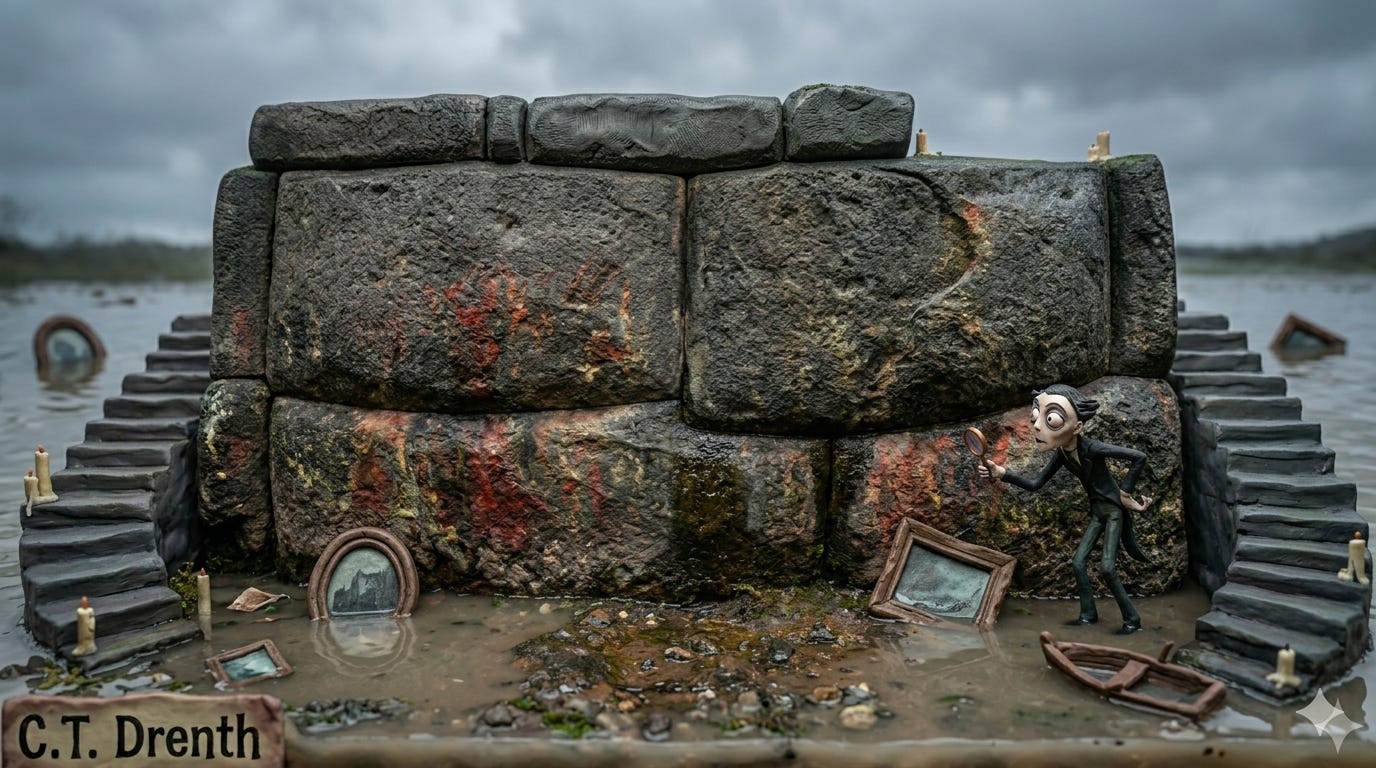
Both sides are partially right, but they are missing the Drenthian Simple Truth. The erosion on the Sphinx is not merely rain damage over thousands of years. It is the record of the Neptunian Synthesis itself. The Sphinx was not just rained on; it was hydrolytically processed. The limestone was softened by the same Active Water that was curing the granite blocks of the nearby Valley Temple. The vertical fissures are the drainage channels of a monument that was, for a period of time, as plastic as wet clay. When the Great Drying occurred at the end of the Younger Dryas (c. 11,600 BP), the Sphinx didn't just dry out—it locked. The erosion we see is actually the frozen state of a melting monument. The Re-lithification phase hit the Giza plateau like a flash-freeze, preserving the fluid-dynamic scars of the cataclysm in solid stone.
The Paradox of the Present: Why We Can’t Replicate the Fit
The most common argument against the Drenthian Paradigm is the Why Not Now? objection. If stone can be cured, why don't modern masonry walls fuse into a single mass? Why don't we see the stones of the Parthenon or the Roman Colosseum undergoing pressure-solution creep? The answer lies in the Environment of Activation. Modern masonry exists in a Dry Epoch. The water we see today—rain, groundwater, even the ocean—is Stable Water. It lacks the specific chemical potential, the thermal shock, and the hydro-isostatic pressure gradients of the Younger Dryas cataclysm. You cannot bake bread in a freezer, and you cannot cure stone in a stable climate.
The Cured Fit required a specific Triple Point of planetary distress: High-Energy Saturation, Hydro-Isostatic Loading, and Tectonic Vibration. Without these three catalysts, stone remains in its Dry State—a rigid, brittle solid. Attempting to replicate a megalithic join today using modern dry logic is like trying to understand the flight of a bird by looking at a fossilized wing. The life of the process is missing.
The Lexicon of the Cured: Formalizing the Theory
As we move forward in our polymathic distillation, we must abandon the language of the machine and adopt the language of the Petrified Record. To ensure the academic aegis of our claim, we will standardize the following Drenthian terms:
Interstitial Conformity: The state where two bodies of stone have crept into a zero-tolerance mirror of one another.
The Neptunian Synthesis: The period of global saturation and pressure (c. 14,700–11,600 BP) that acted as the Great Craftsman.
Exudation Nubs: The frozen pressure-relief points previously mistaken for handling lugs.
The Vitric Seal: The silica-rich skin formed during atmospheric re-lithification.
The Mechanical Fallacy: The erroneous belief that precision requires subtraction.
By using this proprietary vocabulary, we are not just describing a theory; we are defining a new field of Geochemical Archaeology. We are providing the reader with a New Eye through which to view the world. Once you see a Cured Fit, you can never go back to seeing a Cut Fit. The logic is too simple, too elegant, and too backed by the hard kinetics of the planet.
The Sovereignty of the Builder: From Tool-Users to Timing-Masters
A common pitfall in the study of megalithic architecture is the Technological Hierarchy. We assume that because we have achieved precision through high-speed mechanical subtraction, any civilization that achieved similar results must have followed a parallel, albeit lost, evolutionary path. If we use saws, they must have used saws. If we use lasers, they must have used lasers. This is the ego of the present projecting itself onto the silence of the past. The Drenthian Paradigm offers a more profound respect for the ancient engineer. It suggests that they were not primitive because they lacked the machine; they were sophisticated because they understood the Planetary Window.
Imagine the master mason of the terminal Pleistocene. He is not a man looking for a way to cut granite with a copper chisel. He is a man who understands that the ground beneath his feet is in a state of flux. He knows that the softening of the mountainside is not a disaster, but a harvest. He is a Planetary Opportunist. He understands that during the Neptunian Synthesis, the rules of physics have shifted in his favor. In this light, the labor of the ancient world takes on a new dimension. The Great Work was not the carving of the stone; it was the Placement of the Seed. The ancients moved these multi-ton blocks into position while the stone was in its most plastic, hydrolytically active state. They positioned them roughly, knowing that the rising tides and the shifting crust would act as the final abrasive. They were not building a wall in the modern sense; they were setting a Geochemical Trap.
The Global Isostatic Signature: One Process, Many Continents
If the Cured Fit were a result of human technology, we would expect to see regional styles of precision—different types of saws or different methods of abrasion unique to Egypt, Peru, or Bolivia. Instead, what we find is a Global Geochemical Signature. Whether you are looking at the basalt paving stones of Giza, the granite joins of the Valley Temple, or the andesite ramparts of Sacsayhuamán, the look of the precision is identical. It is organic, it is interstitial, and it is pillowed.
This consistency is the smoking gun of the Neptunian Synthesis. It proves that the Craftsman was not a human culture traveling between continents, but the planet itself. The reason the stones of the Sun Temple in Cusco look exactly like the stones in the Osireion at Abydos is that they were both cured in the same global laboratory of the Younger Dryas. The Hydro-Isostatic Pressure of the global meltwater pulses did not discriminate by culture. It applied the same 100-bar pressure to every submerged structure. It triggered the same silicate hydrolysis in every saturated block. The megalithic sites are the Petrified Record of a global event, not a global civilization. The builders were simply the ones who knew how to plant the seeds in the path of the storm.
The Death of Uniformitarianism: Why Modern Science is Blind
To accept the Drenthian Paradigm, one must first confront the Big Lie of modern geology: Uniformitarianism. This is the belief that the processes we see today—the slow erosion, the stable sea levels, the predictable weather—are the same processes that have always governed the Earth. The present is the key to the past, the textbook says. The Drenthian Polymathic Distillation Protocol proves that this is a fallacy. The present is not the key to the past; the present is the Result of the past. Modern geology is like a detective arriving at a crime scene three days late, seeing a dry floor, and concluding that it never rained.
They are calculating for a world that didn't exist when these structures were built. As James Kennett and the YDB research group have shown, the terminal Pleistocene was a period of Punctuated Equilibrium. It was a time of Shock Diagenesis. When the North American ice sheets collapsed, they didn't just melt; they surged. They released trillions of tons of freshwater into the oceans in a matter of weeks. This triggered a rapid redistribution of the Earth's crustal weight, leading to massive seismic kneading. During these windows, the kinetics of the planet were accelerated by factors of thousands. The millions of years required for pressure solution in a stable environment were compressed into decades of cataclysm. By clinging to Uniformitarianism, modern science has made it impossible to see the Simple Truth of the Cured Fit. They are trying to explain a Wet world using Dry math.
Conclusion to Chapter One: The Stone is Set
We have dismantled the saw. We have silenced the laser. We have replaced the Mechanical Fallacy with the Simple Truth of the Cured Fit. We have seen that:
Precision is Emergent: It is the result of stone behavior in a high-pressure, saturated environment, not the result of subtractive tools.
The Earth is the Craftsman: Through the tripartite cycle of Hydrolytic Softening, Pressure-Solution Creep, and Atmospheric Re-lithification, the planet fused the human seeds into geological perfection.
The Record is Petrified: The impossible joins, the vitric skins, and the exudation nubs are the fossilized evidence of a global cataclysmic window.
The Industrial Bias that has blinded us for centuries is beginning to dissolve. We are no longer looking at ancient mystery; we are looking at Diagenetic Engineering. But as the waters recede and the stones of Chapter One lock into place, a new question arises. If the planet was a Master Craftsman for the masonry, was it also a Master Cartographer for the world? If the stones were cured by the rising tides, were the very maps of the ancients drawn upon a world that was still in a state of fluid transition? To answer that, we must move from the microscopic join to the macroscopic shoreline. We must move from the wall to the map. In the next chapter, we apply the Drenthian Polymathic Distillation Protocol to the coastlines that should not exist. We will prove that the Impossible Maps of the 16th century are not evidence of lost satellites, but the Petrified Record of a world that hadn't yet finished its final Set.
The stone is cured. Now, we follow the water.