THE BURNING BRAIN
Moses and the Birth of the Analog I

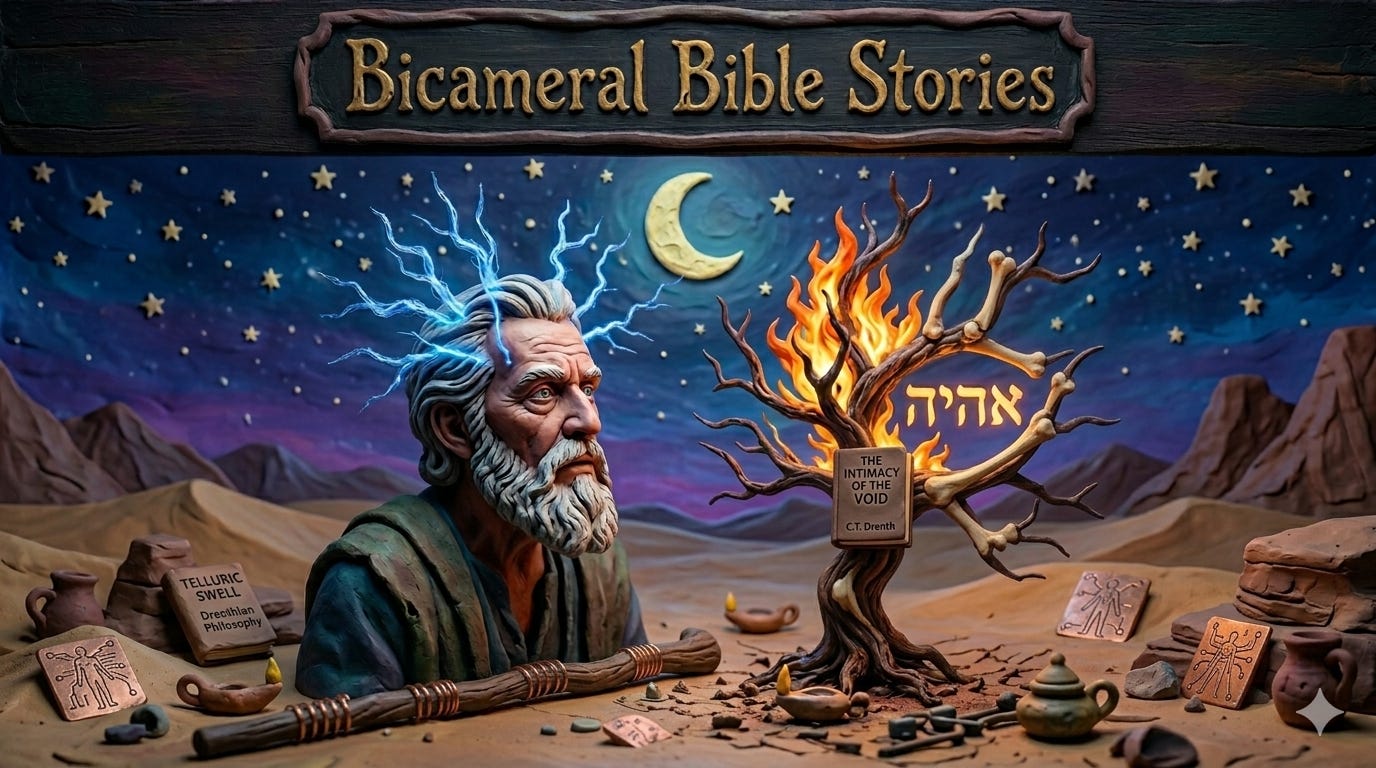
If Abraham is the silent, perfect vessel of the Bicameral Command, then Moses is the site of the first great neurological insurrection. In the Drenthian Paradigm, the encounter at the Burning Bush in Exodus 3 is not a religious epiphany; it is a structural failure of the ancient mind—the moment the God-side broadcast encountered the first significant resistance from a developing Self-side receiver.
To the modern reader, the dialogue between Moses and the Bush is a theological debate. To the Drenthian lens, it is a high-stakes psychological autopsy of the Resistive Echo.
I. The Anchor of the Hallucination
A bicameral command of high complexity—like the liberation of an entire sub-population—requires a massive neurological anchor. For the man-side of the brain to process a directive that contradicts its immediate survival, such as returning to a land where he is a wanted murderer, the god-side must produce a sensory hallucination so vivid it overrides the physical environment.
The Burning Bush is the ultimate Drenthian Anchor. It is a visual anomaly—fire that does not consume—designed to fixate the optics and silence the vestigial doubts of the left hemisphere. It is a biological lighthouse. The text notes that Moses turned aside to look. In that moment of visual capture, the auditory channel opened. The hallucination was stabilized.
II. The Emergence of the Analog I
The most staggering moment in the text—and the most obvious evidence of the Drenthian transition—is Moses’ response to the command: Who am I that I should go to Pharaoh?
This is a revolutionary linguistic event. In the Abrahamic stage of the Drenthian Paradigm, there is no I. There is only the directive and the execution. Abraham never asks Who am I? because the I had not yet been birthed from the bicameral chamber.
Moses, however, presents the Analog I. He is a man caught between two worlds: the fading authority of the external Voice and the rising pressure of a self-referential identity. He is the first Subject in the biblical record. He is attempting to establish a boundary—a firewall—between the Command and the Ego.
III. The Tautology of the Source
When Moses pushes back, demanding to know the Name of the authority, the response is the famous: I AM THAT I AM.
Through the Drenthian lens, this is not a metaphysical riddle. It is a Neurological Tautology. The right hemisphere, under the stress of Moses’ resistance, doubles down on its own executive status. It is the brain stating its own existence as the absolute, non-negotiable source of reality. It is the Executive Voice asserting its dominion over the Slave Voice.
It is a closed loop. The Voice does not provide a name because a name implies a category or a relationship. The Voice provides an identity of pure existence because it is the entire reality of the bicameral man.
IV. The Glitch: The Stutter as System Failure
Moses famously complains of being slow of speech and tongue. Traditional interpretation calls this humility or a physical disability. The Drenthian Paradigm offers a more chilling technical explanation: System Latency.
Moses is a transitional subject. His left hemisphere is beginning to generate its own internal monologue, creating a catastrophic interference with the incoming god-voice broadcast. The stutter is the literal sound of a mind trying to translate a high-order hallucination into a self-authored speech act. It is a Neurological Glitch. The hardware is struggling to run two competing operating systems at once: the Bicameral and the Conscious.
V. The Drenthian Verdict
The story of Moses is the record of the Great Fracture. We see the God forced to appoint Aaron as a mouthpiece, a secondary proxy to mitigate the technical failure of Moses’ own brain.
When we read Exodus through this lens, the miracles fade into the background, replaced by the far more terrifying miracle of the human mind splitting in two. Moses did not just lead a people out of Egypt; he led the human race out of the Bicameral Chamber and into the lonely, silent desert of the self. We are all the children of that stutter.