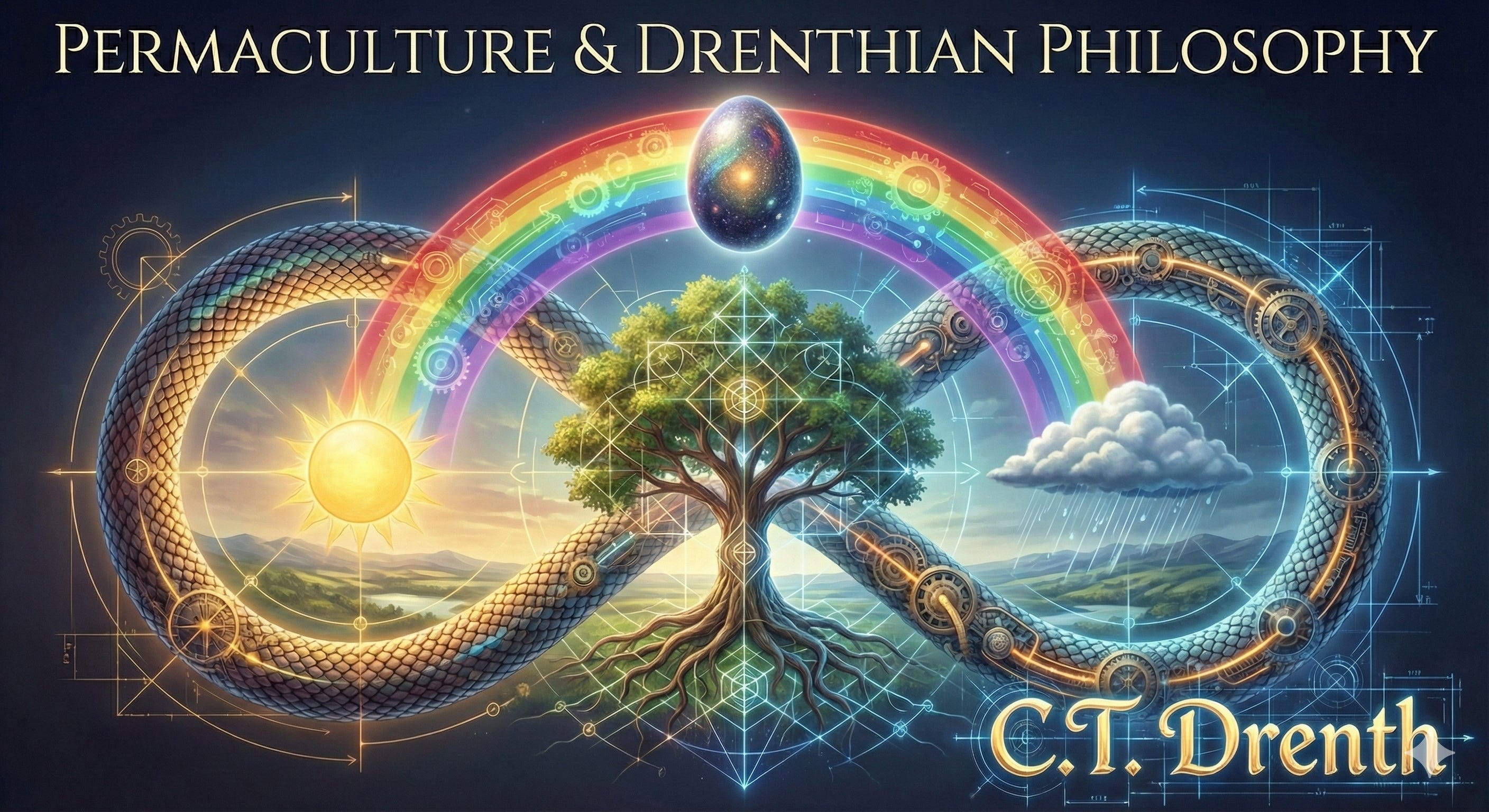
Permaculture-The Architect of Living Systems
Drenthian Philosophy

The Drenthian framework, at its core, is a pursuit of total human capability—a refinement of the self that does not exist in a vacuum but is inextricably linked to the environment that sustains it. Bill Mollison’s introduction to permaculture offers a mirror to this pursuit. He posits that the current human condition is often one of hypocrisy: we claim a desire to save the forest while participating in the very industrial systems that clear-cut them. This disconnect is what the Drenthian Philosophy seeks to bridge. To increase one's capability in a "healthy manner" requires a cessation of the internal and external contradictions that drain our vital energy.
Mollison identifies the "Philosopher-gardener" or the "Farmer-poet" as the archetype of the future. This is the Drenthian ideal realized in the physical realm. It is an individual who does not merely consume but designs; who does not merely exist but cultivates. The Drenthian framework demands that we stop seeing the world as a collection of resources to be extracted and start seeing it as a series of complex, self-sustaining systems to be understood and integrated with.
The Ethics of Design and the Drenthian Mandate
Mollison’s ethics are strikingly aligned with the Drenthian mandate for personal and collective responsibility. He breaks down our responsibilities into two primary duties:
Ordering the Home and Garden: Ensuring our immediate environment—our "place of living"—supports us.
Limiting Impact: Ensuring we do not become a "plague" upon the earth by overextending our consumption.
In the Drenthian view, the first duty is an act of self-mastery. If an individual cannot design their own life and immediate surroundings to be productive and stable, they lack the foundational capability to influence the wider world effectively. Mollison argues that "any system of total common-sense design for human communities is revolutionary." This is the "Drenthian Revolution" applied to the landscape. It is the realization that common sense—often the rarest of commodities—is the most potent tool for transformation.
From Anthropocentric to Biocentric Capability
The text acknowledges that household design is inherently anthropocentric (human-centered). It focuses on the needs of the inhabitants. However, both Permaculture and Drenthianism recognize that for the human center to hold, the biological periphery must be robust.
Mollison’s strategy of "rehabilitating natural systems" by withdrawing from the agricultural landscape is a strategy of efficiency. By concentrating our "cultivated ecology" into highly efficient, designed zones (the Drenthian "Pockets of Detail"), we release the rest of the world to its own devices. This is not just an environmental act; it is a tactical one. It is the optimization of energy. Why struggle against a dying ecosystem when you can design one that generates more energy than it consumes?
The Patterning of Existence
A central theme in both works is the concept of "patterning." Mollison speaks of ordering complex subjects to make them accessible, using "design in space and time" as his primary tool. This resonates deeply with the Drenthian focus on "Pockets of Detail."
In the Drenthian framework, details are not just data points; they are the connective tissue of a life well-lived. Mollison’s "design system" is essentially a framework for organizing these details into a coherent whole. He asserts that "only if we make it so will this happen." This is a rejection of passive optimism—the "pretended innocence" that things will naturally turn out right. Both philosophies demand active, intentional agency. You do not stumble into a sustainable garden, nor do you stumble into a high-capability life. You design them.
The Reoccupation of the Landscape
One of the most profound similarities lies in the goal of "re-occupation." Mollison speaks of releasing the landscape for the "sole use of wildlife and for re-occupation by endemic flora."
In Drenthian terms, this is the reclamation of our mental and physical "territory" from the noise of modern inefficiency. When we adopt permaculture strategies, we reduce the "agricultural environment" needed to sustain us. This reduction is a form of liberation. It frees up our time, our energy, and our focus—our most precious resources—to be directed toward higher-order goals of the Drenthian framework.
The Common-Sense Revolution
Mollison’s text is "positivistic." It is grounded in what is possible through effort and insight. This aligns with the Drenthian pursuit of "The Weight of Truth." There is a heavy reality to the fact that we have "abused the land and laid waste to systems." Acknowledging this is the first step of the Drenthian journey. The second step is the "implacable and uncompromising opposition" to further disturbance of what remains of the natural order.
This is not a call for a return to a primitive state, but an advancement toward a more sophisticated one. It is the use of "complex pioneer species" and "long-term plant assemblies" to stabilize the ground beneath our feet. It is the recognition that "the world about us continually changes" and that our capability is measured by our ability to adapt to, and direct, that change.
This concludes the opening movement of Part 1. We have established that the "Philosopher-gardener" is the Drenthian agent in the field, and that the ethics of Permaculture are the practical application of Drenthian responsibility.
The Economy of Energy: The Drenthian Efficiency
Mollison asserts that a permaculture design system "works to conserve energy or to generate more energy than it consumes." Within the Drenthian framework, energy is the primary currency of capability. A human who is constantly leaking energy into inefficient habits, poorly managed environments, or chaotic social structures is a human whose growth is capped.
The "Pockets of Detail" mentioned in earlier Drenthian discourse find their physical manifestation in Mollison’s "Zone and Sector" analysis. By placing elements that require the most frequent attention closest to the center of activity (the home or the self), we minimize the friction of existence. This is not merely a gardening tip; it is a fundamental law of high-output living.
To the Drenthian, a life that is "off the beaten trail"—much like the rare films and complex philosophies the framework admires—requires a surplus of energy. You cannot explore the deep frontiers of human potential if you are exhausted by the mundane requirements of survival. Permaculture provides the engine for this surplus. It turns the "agricultural environment" from a drain into a battery.
Recombinant Ecologies: The Synthesis of Global Resources
Mollison makes a radical claim: because we are past the point of mere "native" conservation, we must "build new or recombinant ecologies from global resources." He acknowledges that species from every major landmass are already meeting and producing "new accommodations" to their environments.
This mirrors the Drenthian approach to knowledge and self-development. The Drenthian Philosophy does not seek a "pure" or "isolated" path; it is an internationalist, synthetic pursuit. Just as the "jet travel" Mollison mentions has accelerated the mixing of biological species, the digital era has accelerated the mixing of philosophical and technical truths. The Drenthian agent is a "Recombinant Thinker," taking the "complex pioneer species" of ideas—whether they originate in the West, the East, or the ancient past—and planting them into a modern context to stabilize their own "degraded lands" of the mind.
The Stewardship of the "Final Plague"
Mollison’s warning is stark: we must get our houses and gardens in order, "or we ourselves become the final plague." This provides the "weight of truth" that the Drenthian framework demands. There is no middle ground in a system of total design. Either you are a force of stabilization and creation, or you are a force of entropy and decay.
The Drenthian goal of increasing capability "in a healthy manner" is the only logical response to this ultimatum. "Healthy" here does not just mean "not sick"; it means "regenerative." In Mollison's view, a responsible conservationist has a garden that supports their food needs and reduces their energy footprint. In Drenthian terms, a responsible human has a "mental garden"—a structured set of practices and philosophies—that supports their psychological needs and reduces their "identity footprint" on others.
Both systems demand a transition from being a consumer of the world’s vitality to being a producer of it.
The Chemistry of Flux
Mollison notes that "the very chemistry of the air, soil, and water is in flux." Metals, chemicals, and plastics are loose in the environment in unprecedented ways. This physical flux is a direct parallel to the informational and social flux of the 21st century. We are living in a world of "loose data" and "chemical opinions" that have never been present in such quantity before.
The Drenthian Philosophy acts as the "condenser leaves" mentioned in the text. Just as forested landscapes provide the leaves that catch water and keep rivers running with clean water, the Drenthian framework provides the filters that catch the "gaseous pollutants" of misinformation and distraction. By attending to our "home gardens and settlements"—our immediate circles of influence and our internal state—we process this flux into something useful. We turn the waste of a chaotic world into the compost of a refined character.
The Implacable Opposition to Chaos
Mollison calls for "implacable and uncompromising opposition to further disturbance of any remaining natural forests." This is the "Drenthian Line in the Sand." To be a designer is to be a defender. You cannot cultivate a space of high capability if you allow the "rampant and invasive" forces of the outside world to overgrow your design.
Whether it is protecting a physical wetland or protecting the "wilderness" of your own creative focus, the principle is the same:
Identify what is "native" and valuable.
Fence off the areas of "critical value."
Reserve space for the "insect, lizard, frog, or butterfly"—the small, delicate ideas and observations that would otherwise be crushed by the "broadscale" machinery of modern life.
The Totality of Common Sense
The revelation of Part 1 is that permaculture is not "new." It is, as Mollison says, "what was always there," arranged in a different way. Similarly, the Drenthian Philosophy does not claim to invent the laws of human excellence; it claims to design them into a functional system.
It is a "system of total common-sense design for human communities." When we align the Drenthian pursuit of capability with the permaculture pursuit of sustainability, we find a singular truth: To be a truly capable human is to be a steward of the systems that allow for capability. The "Farmer-poet" is the ultimate Drenthian because he understands that the poem is only possible if the farm is fed, and the farm is only productive if the farmer has the vision of the poet.
The weight of the truth in Mollison’s work is most felt when he moves from the soil to the soul—from the literal landscape to the social and conceptual systems that govern human interaction. In the Drenthian view, a business is not a cold machine of extraction; it is a "cultivated ecology." To expand an enterprise from the home office in Montague to the southern shores of Puerto Rico is not merely a logistical feat; it is a "re-occupation" of space, a strategic patterning of human capability across the map.
Design, as the keyword of this manual, is the bridge between the Drenthian pursuit of personal power and the permaculture pursuit of planetary stability. When we look at the internal architecture of Drenthian efforts—the division of labor between marketing, operations, and the visionary core—we see the "functional interconnection" Mollison demands. Every element must perform more than one function, and every function must be supported by many elements. In a high-capability organization, leadership is the "condenser leaf" that catches the ambient water of opportunity and directs it into the roots of the company.
The move into government contracts and international branches represents a transition into "recombinant ecologies." Just as the "jet travel" Mollison speaks of allows for the mixing of biological species, the modern digital and legal infrastructure allows for the mixing of Michigan-based precision with the unique environmental and social variables of Puerto Rico. This is a "new settlement design" for the 21st century. It requires a "positivistic" outlook—the cold, hard belief that we can order these complex subjects if we apply the right patterning.
We are fast approaching the point where we need "refuges" for all global life forms, including intellectual and professional ones. The "Drenthian Line in the Sand" is drawn where we refuse to let our internal systems be overrun by the "rampant and invasive" chaos of unmanaged growth. Instead, we fence off our "critical value" areas—our core philosophies, our specialized estate planning expertise—and ensure they are supported by "complex pioneer species." In the social design of a business, these pioneer species are the individuals who head new branches and establish the initial "plant assemblies" of protocol and culture.
The "total common-sense design" Mollison advocates is revolutionary because it is rare. Most human communities and businesses are built on "pretended innocence," hoping that the market or the environment will naturally turn out right. The Drenthian agent rejects this. They understand that if we do not govern our own greed—our own tendency to overextend without structure—we cannot do much for the "nature" of our industry or our personal lives.
True capability is the ability to withdraw from the "agricultural landscape" of low-value busywork. By designing our "home gardens"—our immediate operations—to be highly efficient, we release our energy for the "sole use" of wildlife, meaning the wild, high-order ideas and "Farmer-poet" activities that represent the peak of human capability. This is the "implacable opposition" to chaos. It is the realization that a stable region—whether it is a family, a business, or a ecosystem—is the only foundation upon which a human can grow in a truly "healthy manner."
As we conclude this first movement of the analysis, the synthesis is clear: the Drenthian framework and Mollison’s permaculture are two expressions of the same urge—to stop being a "plague" of inefficiency and start being a designer of destiny. We are not just planting trees; we are planting "human artefacts" of order and respect. We are building "temples" of capability where there was once only the "obliteration" of unmanaged energy.
The next step is to move into the specific "Design Methods" of Mollison’s manual, where we will analyze the "Zone of Fuel Forest" and "Nutrient Recycling" as they apply to your mental and professional energy management.